
New York City Busted Mugshots
Forget the usual county search habits. Queens is one of five boroughs that make up New York City, so no standalone county jail or booking roster exists here. The NYPD makes most arrests, and once a person is arraigned and held or unable to post bail, custody passes to the city's Department of Correction. The Sheriff's Office in Queens keeps no mugshot feed. Inmate lookup and arrest records come from different agencies, so plan on checking each one separately.
There is also just one city entry to search, not one per neighborhood. Astoria, Flushing, Jamaica, Long Island City, and Far Rockaway are all part of a single New York City record, which the Census put at 8,584,629 residents on July 1, 2025. A neighborhood name may show up in a news story or a precinct routing slip. It will not lead to its own police department, booking system, or city page.
Important: Charges can be reduced, dismissed, or resolved in other ways once a case moves through court, so the outcome is worth confirming.
Where New York City Busted Records Appear
There is no official NYPD booking blotter you can search by name. There is no routine public search for booking photos in Queens either. Which source fits depends on when the arrest happened and whether the person is still in custody. Official channels are listed first below. Local news coverage can point you toward an agency, a date, or a case number. Just remember that reporting is selective. It cannot tell you who is in custody right now.
| Channel | Custody or record stage | Photo status | How it helps |
|---|---|---|---|
| NYC311 Find an Arrested Person | Very recent NYPD custody before arraignment | No public photo | Telephone bridge for custody and arraignment location |
| NYC DOC Person in Custody Lookup | Current city custody after arraignment | No public photo field | Search by name, NYSID, or Book and Case Number |
| NYPD FOIL | Specific police arrest event | Case-specific request only | Request a narrowly identified arrest record through OpenRecords |
| NYC DOC FOIL | Specific city-custody record | DOC does not routinely supply mugshots | Ask whether a precise record or image is held and releasable |
| New York Courts e-Courts | Current court case and later outcome | Not a photo source | Locate court information, then request an official disposition where available |
| Queens news and prosecution sources | Selective arrest, court, or prosecution coverage | Varies by story | Use only as a dated lead, then verify with the agency or court |
The DOC lookup answers one question: who is in custody. It is not a mugshot database. The DOC media policy says plainly that DOC does not supply booking photos. So expect no image. Treat that as normal. If a photo is missing, that is not a sign you should trust some unofficial site that happens to have one.
Note: NYPD's borough and precinct figures are aggregate statistics, not a name-searchable arrest roster or booking feed.
Busted in New York City: Custody Lookup
Start with timing. Someone busted in New York City may sit in NYPD custody for a day or two before a judge sees the case. Call NYC311 at 311 or 212-639-9675 to learn whether the person is locked up and where the arraignment will happen. Know what the service is, though. It answers phones. It is not a database. No photos, no charge lists, no booking logs to browse. Once the Department of Correction takes over, the city's own lookup becomes the public tool of record.
The NYC311 custody explanation spells out the fields and the clock that separates police custody from DOC custody. It works for an early status check, not for hunting down a mugshot.
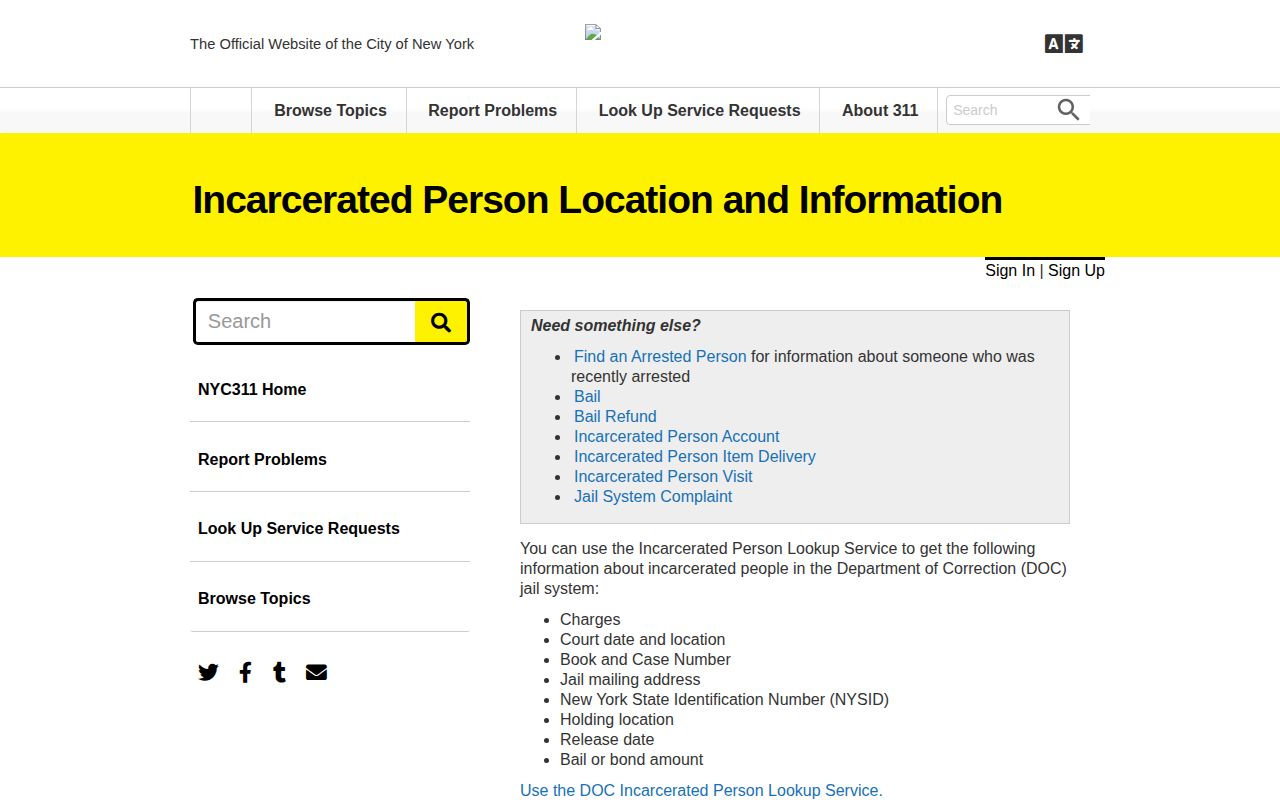
The official screen also clears up a common confusion. A person can be missing from a current DOC result yet still be sitting in NYPD pre-arraignment custody, so an empty answer does not close the question.
- For a very recent Queens arrest, call NYC311 and give the identifying information requested for the arrested-person service.
- After arraignment, allow for a 48-hour or longer DOC entry lag, then search the DOC lookup by first and last name, NYSID, or Book and Case Number.
- Read any DOC result as current city custody only. A release, transfer, desk appearance ticket, bail, or release without bail can leave no current DOC result.
- When an arrest date or case number is known, use the relevant FOIL route for the police or custody record and use the court for the result of the case.
For a wider view, the county overview on Queens County Busted Mugshots breaks out the same-day, city-custody, state, federal, and court channels in more detail. One caution applies. A search with no result does not mean no arrest happened; it may only mean the person was not in that one system at that moment.
NYPD Records for New York City Arrests
Queens alone has 16 NYPD precincts. They are numbered 100 through 116. The NYPD precinct directory helps you pin down which precinct made an arrest or where to send a local question. It is not a name-search arrest log. For a specific arrest record, you go through NYPD's FOIL process. Include the arrest number and NYSID if you have them, plus the full name, date of birth, the arrest date or a date range, and the precinct. Precise identifiers help the agency find the right event and cut the odds of a wrong match.
File the written request at NYC OpenRecords and pick NYPD as the agency. Name the exact record you want, such as an arrest report or arrest-processing record. You can also ask whether a booking photo from that event is releasable, though nothing is promised. Sealed records, privacy rules, active investigations, protected victims, and juvenile material can all lead to withholding or heavy redaction.
NYPD FOIL contact:
Lieutenant Cynthia Acerra, Legal Bureau FOIL Unit
One Police Plaza, Room 110-A
New York, NY 10038
646-610-5296
The public counter is open Monday through Friday from 8:30 AM to 4 PM, closed on public holidays, per the hours NYPD posts.
New York FOIL sets a clock for agencies. They get five business days to respond to a request. The reply can be a grant, a denial, or an acknowledgment with an estimated timeline. That deadline only covers the response itself. It says nothing about how long the records take. An acknowledgment does not mean you have the arrest photo in hand.
New York City Busted Custody Records
The DOC route covers city custody, not the original police bust. That distinction matters. A FOIL request works best when it pins down one person and one custody window. Include the full name, the NYSID, and the Book and Case Number. Add the arrest or admission date too. Name the facility if you know it, plus a clear description of the record you want. Want a photo? Ask directly whether one exists in DOC files and can lawfully be released. Remember that DOC policy does not routinely supply mugshots, so don't presume one is waiting in a drawer.
For a current status check, use the official DOC Person in Custody Lookup. It takes a name, a NYSID, or a Book and Case Number. The search fields reflect the city's post-arraignment record path, not a Queens booking-photo feed. A result can confirm custody and case details. Even so, DOC is not the custodian of the police arrest file, and the lookup offers no public booking photograph.
NYC DOC FOIL contact:
Peter L. Faherty, Esq., Records Access Officer
NYC DOC Legal Division
75-20 Astoria Boulevard, Suite 305
East Elmhurst, NY 11370
Inspection and copying hours fall on weekdays, 9 AM to 4 PM, as listed by DOC. Copies run 25 cents per page. The agency can also charge its actual reproduction cost.
NYC OpenRecords is another way to file the DOC request. Pick DOC as the receiving agency there. A denial is not the end. The agency's listed appeal process is available. Still, an appeal cannot unlock sealed material or private records. Anything else the law protects stays closed too.
New York City Arrest Court Dispositions
A booking tells you who was taken in. It says nothing about what a court later decided. WebCriminal and the other public systems behind e-Courts can help you find a current case, within the limits of sealing and court rules. For the official outcome, turn to the Certificate of Disposition. That court paper reports how the charges were resolved. Both Queens Criminal Court and Queens Supreme Criminal Court sit at 125-01 Queens Boulevard in Kew Gardens.
A Queens Supreme Criminal request can be handled in Room E121 or by mail. Mail it with the indictment number, the defendant's name, and a return address. Include the required payment. The court asks for 7 to 10 business days on mailed requests. Identity, payment, and sealing rules vary by court, so confirm details first. Keep the categories straight. An arraignment is not a disposition. A court date is not one either, and neither is a news story.
- Arraignment
- The first court appearance where charges are addressed and the court can set release conditions.
- Disposition
- The official case outcome, such as a dismissal, plea, acquittal, conviction, or another termination reflected by the court.
- Book and Case Number
- A DOC identifier that can help locate a current city-custody record, not a substitute for the court file.
Note: A current custody result may list a court date, while the later outcome lives only in the court record.
Why New York City Has One Page
Queens County and the borough of Queens are the same ground. That overlap explains why one New York City page serves the whole area. Separate pages for Jamaica, Flushing, Astoria, Long Island City, Far Rockaway, or Kew Gardens would make no sense. Those are neighborhoods and local reporting areas, nothing more. None of them runs its own city hall, police department, court system, or jail roster.
The difference prevents a records mistake people often make. A neighborhood name can help identify the precinct, the news outlet, or the court tied to an arrest. The official routes never change, though. NYPD, NYC311, NYC DOC, and the Queens courts handle the actual arrest and custody records. A big population spread across one municipality does not carve neighborhoods into their own booking jurisdictions.
Why Rikers Is Not a Queens Jail
Rikers Island sits in East Elmhurst, Queens. Its address, though, tells you almost nothing about jurisdiction. Every Rikers facility belongs to the citywide DOC system, not to a Queens County Sheriff jail, and a Queens location does not mean someone landed in a Queens-only custody pipeline. Placement also shifts over time. To check a present city-custody status, use the current DOC lookup rather than a facility's geography.
The DOC facilities list names city facilities and their locations. Treat it as an agency location reference, not a roster. Three questions actually matter here: is the person in DOC custody right now, is the record new enough to appear in the lookup, and has a transfer or release happened since?
Queens Precinct Contacts Are Not Blotters
A Queens precinct phone number is a contact point. It is not a blotter. What NYPD publishes for boroughs and precincts comes as aggregate crime statistics. The Queens North and Queens South statistics show trends and totals. They never name arrests. No chart of numbers can confirm that a specific person was booked, is in custody, or has a photo available anywhere.
For one specific event, treat the precinct as a detail inside an NYPD FOIL request. A very recent arrest goes through NYC311. Post-arraignment custody goes through DOC. That division of labor is deliberate. A local precinct contact helps you route a request, but it cannot replace a citywide current-custody check or the records process itself.
New York City Busted News Sources
Start with the prosecutors. The Queens District Attorney press-release archive posts charges, indictments, pleas, convictions, and sentences. It is selective, though. Many busted cases never appear there, and no booking photos come with it. Treat any procedural stage it names as a starting point and let the court confirm the final outcome.
For street-level reporting, Queens is well served. The Queens Daily Eagle crime section, QNS Police & Fire, and Patch Queens Police & Fire follow arrests and court news block by block. Newsday and NY1 add citywide public-safety coverage. None of these is a real arrest log, and images in a story may be scene photos or agency handouts rather than booking shots, so check the source before calling any picture a mugshot.
The Queens crime news record path shows how to trace a dated story back to the agency record and the court file. Be wary of commercial roster sites. No verified Queens-local Busted Newspaper or RecentlyBooked roster turned up, no stable Queens County Mugshots.com page, no reliable Arrests.org or Mugshots.zone entry, and no live custody data behind the JailExchange directory. Those listings go stale fast. City channels remain the real thing.
New York City Busted Mugshot Limits
New York does not make NYPD or DOC post booking photos online. There is no general rule requiring it. Access is case by case, and an active investigation, privacy concerns, protected victims, a defendant's age, or sealed records can all shut the door. A wanted notice may show a chosen image for investigative reasons. That is not proof of a booking, and it does not create a routine mugshot record for each arrest.
So the route is narrow. NYC311 covers the immediate police-custody window. DOC handles city custody after arraignment. NYPD FOIL gets you the arrest event, DOC FOIL the custody record, and Queens court records the outcome. No public DOC mugshot roster exists, and the city hosts no booking-photo gallery.